Introduction
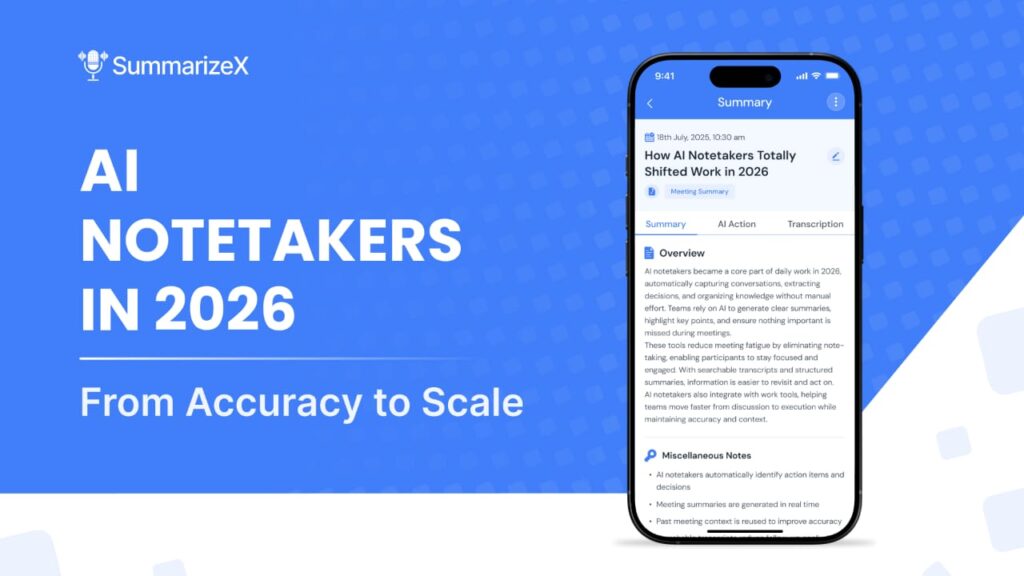
AI notetakers have ceased to be a nice-to-have. They are silently integrated into the operations of modern teams, where they hold meetings, make decisions, and move the work forward in 2026. The previous questions about accuracy have been replaced with the new questions about continuity, coordination, and scale.
Due to the increasing number of meetings and more distributed teams, it is not about whether an AI notetaker is working, but whether it can sustain friction-free. That modification changes everything.
Let’s explore how expectations change, why scale becomes the true differentiator, and what features make an AI notetaker truly essential today.
Why AI Notetakers Feel Effortless at the Start
For individuals and small teams, AI notetakers often feel almost magical. You join a meeting. You speak naturally. You leave with:
- A clean transcript
- A clear summary
- A simple list of action items
There’s no setup friction. No learning curve. No extra effort required.
For light usage, this experience feels complete. Meetings are usually short. Follow-ups are manageable. Reviewing notes takes a few minutes at most. At this stage, free plans often feel more than sufficient.
So an honest question arises early on:
What are we supposed ever to need more than this?
Due to the expected functionality, there is no need to doubt the tool and look at alternatives at once. The AI accomplishes its task, and it accomplishes it well.
But this early experience represents the simplest version of meeting work. And simplicity rarely lasts.
How AI Notetaking Technology Has Matured
In recent years, AI notetakers have developed at a very high rate. The features that previously had to be done manually are now automated by default.
Today’s tools can:
- Transcribe entire meetings in real time
- Understand different accents and speaking styles
- Highlight key discussion points automatically
- Extract decisions and next steps with minimal input
This level of maturity means something important: the core intelligence behind many free and paid AI notetakers is often very similar.
Accuracy, language understanding, and basic summarization are no longer premium-only capabilities. They’re expected.
Which leads to a subtle but critical change:
If accuracy is table stakes, what actually separates one AI notetaker from another?
The answer isn’t what the AI can do once. It is what it can do in dozens or hundreds of meetings without the need to produce new work.
When Accuracy Stops Being the Bottleneck.
By 2026, teams expect accuracy by default. A transcript that’s mostly correct is no longer impressive, it’s assumed.
What starts to matter more is everything that happens after the meeting ends:
- How quickly can someone understand what was decided?
- Are action items easy to track across multiple meetings?
- Does the AI reduce follow-up work or quietly create more of it?
At low volume, these questions don’t feel urgent. But as meetings increase in frequency and importance, they become impossible to ignore.
This brings a practical issue that most teams do not consider at the beginning:
Will we save time, or will we just transfer the work to the post-meeting?
When accuracy alone carries the system, scale becomes the breaking point.
Where Scale Changes the Game
As teams grow, meetings change.
They become longer. They happen more often. They include additional stakeholders, additional context, and additional dependencies. The decisions made during a given meeting usually depend on the discussions in several meetings.
At this point, teams hardly have a problem since their AI notetaker is inaccurate. They struggle because managing volume, continuity, and coordination becomes harder.
Scale introduces complexity in ways most teams don’t plan for.
1 Longer and More Frequent Meetings
A 20-minute check-in is easy to summarize. A two-hour planning or strategy session is not.
As meetings get longer, teams need more than raw transcripts. They need:
- Clearly structured summaries
- Separation between discussion, decisions, and action items
- The power to re-experience the important points without having to reread.
Ask yourself:
When a person is absent from a long conference, will he be able to know the result within five minutes or thirty?
Without structure, even accurate notes become difficult to use.
- Context Across Multiple Meetings
No meeting exists in isolation.
Real productivity comes from understanding connections over time:
- Which decisions keep resurfacing?
- Which action items remain unresolved week after week?
- Where are teams repeatedly getting blocked?
This necessitates AI, which does not summarize individual meetings; it interprets them as having a continuous workflow.
A key question arises here:
Can your AI notetaker remember what your team has already discussed, or does every meeting start from scratch?
Context is where scale either compounds value or quietly drains it.
- Notes That Fit Into Daily Work
As usage grows, meeting notes can’t live in isolation.
Teams expect insights to flow naturally into:
- Project management tools
- CRMs
- Knowledge bases
- Internal documentation systems
Early on, manual copy-pasting feels harmless. At scale, it introduces friction, inconsistency, and delay.
Consider this:
How often do important decisions stay trapped inside meeting summaries instead of driving action elsewhere?
Integration isn’t a convenience feature, it’s a scaling requirement.
- Security That Supports Long-Term Use
More meetings also mean more sensitive information. Strategy discussions, financial details, hiring plans, and customer insights all pass through AI systems as usage grows.
When AI becomes embedded in daily operations, security and privacy stop being background concerns. They become foundational.
The question turns from: Is this tool secure enough to try? To: Can this be trusted over the long-term?
What is to Expect in an AI Notetaker, 2026?
With time, the maturing teams, an AI notetaker is not about feature lists, long-term fit is the appropriate choice.
Here’s what actually matters at scale.
- Reliable Real-Time Transcription
Real-time transcription should remain stable regardless of meeting length or frequency. Whether it’s a quick sync or an extended planning call, performance should be consistent.
If accuracy drops under pressure, trust erodes quickly.
- Smart Summaries That Drive Action
Effective summaries do more than restate conversations. They surface outcomes clearly:
- What was decided
- Who owns which tasks
- What happens next
The fewer manuals that are cleanable, the more value the AI introduces.
Ask yourself:
Do you find your summaries helpful in reducing decision fatigue, or are they just another item on the review list?
- Seamless Integrations
The best AI notetakers are those that quietly perform their work in the background. They are compatible with the existing tools and minimize the rate of switching between contexts rather than a new set of dashboards.
When notes are carried over into everyday systems, adoption is realized.
- Powerful Security and Privacy Foundations.
Encryption, access controls, and compliance are not the nice-to-have features of AI, since it can run business-critical conversations. They are vital infrastructure.
Trust scales only when security does.
- Adaptability Over Time
Different teams meet differently. Modern AI notetakers should adapt to:
- Varying meeting formats
- Different industries
- Evolving workflows
The best tools become more useful the more they’re used.
The Real Trade-Off Isn’t Free vs Paid, It’s Friction vs Flow
Teams rarely upgrade an AI notetaker because something is broken. They upgrade because friction quietly accumulates:
- Time spent reviewing long transcripts
- Manual tracking of follow-ups
- Lost context across weeks of meetings
Even minute inefficiencies are magnified in cases where meetings form the main way of doing work.
The question is just a question to say the truth:
Is our AI helping us move faster, or are we compensating for scale manually?
Features That Define Scalable AI Notetakers
By 2026, teams operating at scale expect AI notetakers to provide:
- Context-aware summaries that adapt to meeting type
- Real-time collaboration during and after meetings
- Cross-meeting insights that surface recurring themes and blockers
- Automated follow-ups that reduce manual coordination
These capabilities don’t replace free tools; they extend them as teams grow.
Balancing Cost and Value as Usage Grows
Upgrading an AI notetaker is rarely a sudden decision. It happens gradually, as teams recognize where time and clarity are being lost.
The real evaluation becomes less about pricing tiers and more about impact:
Are we leveraging or trading with attention and effort?
The value of AI increases as time saved by reviewing content is reduced, better clarity is achieved, and the teams remain on track.
Final Words: Accuracy Is the Baseline. Scale Is the Future.
The state of free AI notetakers in 2026: Accurate, capable, and the best place to begin.
However, teams require more than transcripts as the number of meetings increases, the duration of meetings increases, and their significance increases. They require continuity, coherence over dialogues, and structures that accommodate the way work occurs in reality.
The real question isn’t whether an ai meeting notes assistant works. It’s whether it’s ready to grow with your meetings, your teams, and your ambitions.