Introduction
We are in more meetings than ever before, and still, after we are in the same meetings, we are asking ourselves the same questions: What was decided? Who owns what? And what happens next?
The nature of productivity has never remained consistent with technology, however, the current change is more than speed or efficiency. Even work is being restructured. Meetings, which previously were perceived to be a time drain, are becoming a source of clarity, accountability and momentum. The AI meeting note taker is at the center of this change.
A world that is fast-paced and judgemental in the context of the situation can no longer afford to maintain the use of memory or scribbled notes. The current professionals are present in a larger number of meetings than ever before, but they cannot get clarity out of them. Here is where AI-based meeting intelligence is silently transforming contemporary work.
But what exactly are AI meeting note takers doing to productivity, and why are progressive organizations implementing them as standard infrastructure and not as a supplement?
Transforming Insights into Achievable Outcomes
Meetings can provide insight, decision-making, and intent, but the vast majority of their inherent value is typically lost at the conclusion of a meeting. Note-taking is often selective, subjective, and incomplete. Even shared minutes rarely capture nuance, follow-ups, or accountability clearly.
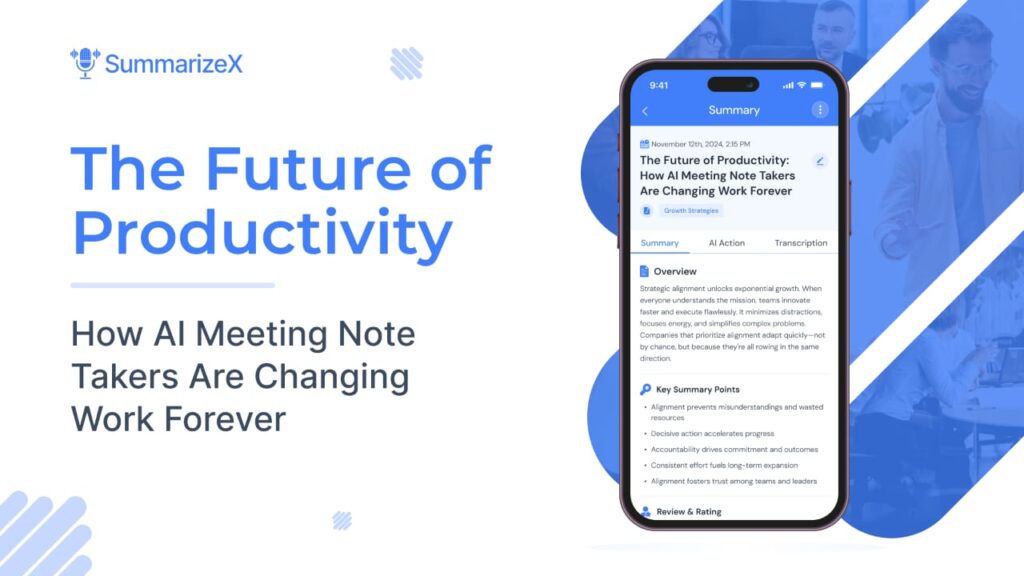
An AI meeting note taker changes this dynamic by converting conversations into structured, reliable data. The modern systems do not give the exact transcripts but pinpoint key themes, decisions, action items, and context. This enables teams to stop the friction that comes with taking a step between What did we decide? What is next?
The question that this change has brought many leaders to ask internally is: How is AI transforming the future of work?
The reason is that the work is becoming more and more asynchronous, traceable, and decision-based as opposed to being reliant on live alignment at all times.
The Rise of AI Transcription Tools and Meeting Automation
The early AI transcription tools were mainly aimed at accuracy, which transformed speech into text. Although that was one issue, it did not seem to resolve the bigger issue of information overload. Even long transcripts are time-consuming to read and hardly lead to action.
Today’s solutions combine transcription with meeting automation, layering intelligence on top of raw data. They automatically:
- Detect decisions and commitments
- Highlight risks or unresolved points
- Assign and track action items
- Summarize outcomes by topic or stakeholder
This evolution means meetings no longer end when the call drops. Instead, they feed directly into workflows, documentation, and planning systems.
Now it is natural to ask the question: How do AI notetakers work?
In order to determine intent but not words, they employ advanced language models that have been trained to recognize conversational information, such as ownership indications, priority signals, and decision-making language.
Productivity Is No Longer About Doing More
For experienced professionals, productivity does not mean doing more things in a given day, but rather eliminating cognitive demands and making decisions of high quality at a faster rate. Teams are restricted by being interrupted to change contexts, constantly receiving information to update, and manually recording information. Hence, their actual productivity is less than they would actually believe.
This is where AI-driven meeting intelligence creates leverage. By automating capture and synthesis, teams reclaim mental space for strategic thinking. Instead of revisiting conversations, they operate from shared clarity.
This leads to a deeper question: how will AI improve productivity?
Not to take over human judgement, but rather to eliminate the resistance to humans being able to effectively use their judgement. AI can absorb that workload, allowing everyone to concentrate on outcomes.
Meetings as a Strategic Asset vs Time Sink
Leadership teams rely on meetings to stay aligned or to become misaligned. Yet many organizations still treat meeting outputs as disposable. Notes are scattered across tools, action items lack ownership, and decisions get revisited repeatedly.
An AI meeting note taker turns meetings into a living knowledge base. Every discussion becomes searchable, comparable, and reusable. In the end, this creates Institutional Memory for most rapidly expanding organizations, which they struggle to maintain for many reasons.
This leads to another important consideration: What could AI do to make meetings more constructive?
The solution is in consistency, by making sure that no matter who is present at the meeting table, the results of that meeting are also structured to continue the work.
How to scale teams without scaling confusion.
Alignment becomes more difficult as organizations expand. This increases the number of meetings, handovers, and the possibility of miscommunication. Human processes do not scale with intelligent automation.
Meeting automation enables:
- Faster onboarding through historical context
- Better cross-functional visibility
- Reduced dependency on synchronous updates
- Clear accountability without micromanagement
A question many scaling teams are beginning to ask is, Can AI help reduce decision latency in growing organizations?
When decisions are captured, summarized, and distributed instantly, speed doesn’t stall waiting for clarification.
Trust, Accuracy, and Professional Adoption
For advanced users, trust is non-negotiable. Adoption depends on accuracy, security, and clarity, not novelty. The current AI meeting software is built with business-level functionality, providing managed information management and transcription fidelity by accent, field, and speech patterns.
The second arising question is: Can AI-generated notes be relied upon to make relevant decisions?
When artificial intelligence systems are designed to be used in the workplace, the response to that is more often yes, particularly when they reduce human supervision instead of eliminating it.
The Future Is Already Here
AI meeting note takers are no longer experimental tools. They are taking over the position of the way modern teams work, the way calendars, email, and project management systems did.
The future of productivity does not lie in the number of meetings to be attended but in how to get more out of the meetings that can be really counted. Having smart meeting automation and AI transcription tools will make work easier, quicker, and more deliberate.
Final words: Productivity Powered by Clarity
Our working habits are evolving not due to a lack of meetings, but due to the fact that they are actually becoming beneficial, besides the actual call. An AI meeting note taker turns discussions into organization, agreement, and progress.
With tasks that are increasingly fast and significant, no longer do the mind or even the handwritten notes suffice. The winning teams will be the ones that consider meetings as strategic inputs and apply AI to extract the best out of them.
Are You Prepared to Have Smarter Meetings?
When you are ready to change discussions into decisions and notes into actions, you need to reevaluate the way your meetings make your business work.
SummarizeX is an easy way to capture, comprehend, and take action on insights ai meeting note taker meetings that will make sure that nothing noteworthy is lost.
👉 Transform your meetings into productivity engines. Try SummarizeX today.