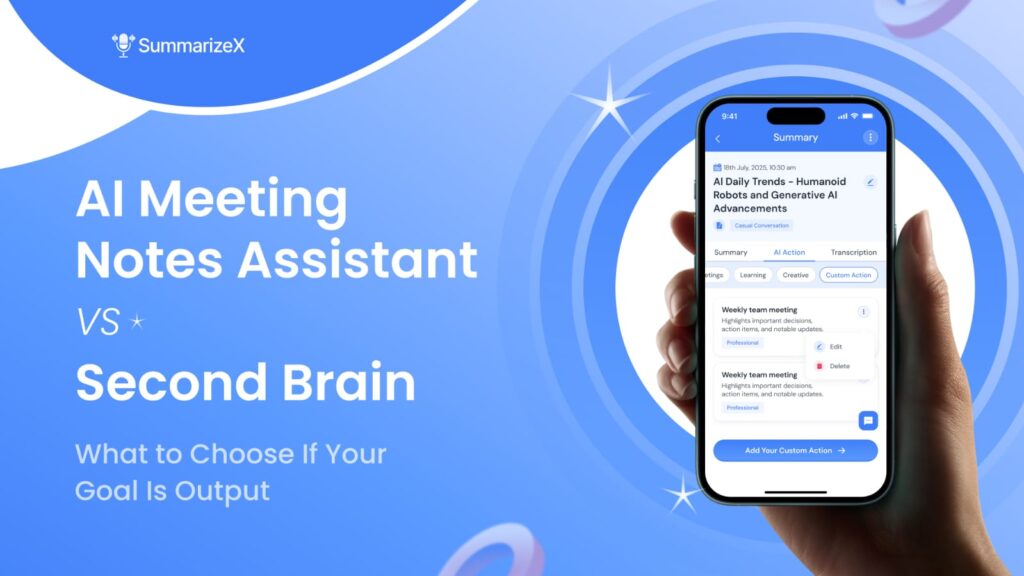
Introduction
There’s no shortage of productivity systems today. Some professionals swear by building a “second brain.” Others are rapidly shifting toward AI-powered tools that promise instant clarity and action. But let’s pause and ask a more important question: Are you trying to store information… or actually use it?
Because that distinction changes everything.
A lot of modern workflows are designed to help you collect knowledge. Very few are designed to help you convert that knowledge into output.
And in today’s fast-moving work environment, output is what truly matters.
- Decisions need to happen faster
- Meetings need to lead to action
- Information needs to move – not sit in documents
This brings us to a critical comparison:
AI Meeting Notes Assistant vs “Second Brain” systems
Both sound powerful. Both promise productivity.
But if your goal is execution, clarity, and real results – which one actually delivers?
Let’s break it down.
1. What Is a “Second Brain” System?
The concept of a “Second Brain” is simple – A personal system where you store, organize, and retrieve information.
It usually involves:
- Note-taking apps
- Knowledge databases
- Manual tagging and organization
- Frameworks like PARA or Zettelkasten
The idea is powerful.
You build a digital extension of your brain – a place where everything is stored for future use.
At first glance, it feels like the ultimate productivity system. But let’s pause for a second and reflect:
How often do you actually go back and use everything you store?
Because there’s a hidden gap here. Storing information feels productive.
But it doesn’t automatically lead to action. And that gap becomes more visible the busier your work gets.
2. What Is an AI Meeting Notes Assistant?
An AI meeting notes assistant takes a completely different approach.
Instead of focusing on storage, it focuses on transformation. It captures conversations and turns them into actionable output.
Here’s how it works:
- Records meetings automatically
- Converts speech into structured notes
- Identifies key decisions
- Highlights action items
- Creates summaries instantly
Tools like SummarizeX are built around a simple principle:
Meetings shouldn’t end with notes. They should end with clarity. And that clarity is what drives execution.
Now think about your last meeting.
Did you walk away with clear next steps or just a long transcript? Because that difference directly impacts productivity.
3. The Core Difference: Storage vs Output
At a high level, the difference is straightforward but powerful.
| Second Brain | AI Meeting Notes Assistant |
| Stores information | Converts conversations into action |
| Requires manual input | Works automatically |
| Focuses on long-term knowledge | Focuses on immediate execution |
| Needs constant maintenance | Delivers instant usability |
| Passive system | Active system |
A “Second Brain” is like a well-organized library.
An AI meeting notes assistant is like a proactive project manager.
Both have value. But only one is designed to move things forward immediately. So the real question becomes:
Do you need better organization… or faster execution?
4. Where “Second Brain” Works Well
To be fair, “Second Brain” systems are not without value. They work exceptionally well in scenarios where:
- You’re doing research-heavy work
- You need long-term knowledge storage
- You’re building ideas over time
- You prefer structured thinking over speed
For example:
- Writers collecting ideas
- Researchers organizing data
- Strategists mapping complex concepts
In these cases, storing and connecting information is useful. But let’s bring it back to everyday work.
Is your daily workflow about building knowledge slowly or acting quickly?
Because most modern roles demand speed. And that’s where the limitations start to show.
5. Where It Falls Short
This is where the “Second Brain” approach begins to struggle. Over time, maintaining such a system requires:
- Continuous effort
- Manual organization
- Regular revisiting
- Discipline to extract value
And something predictable happens.
Your system becomes – A collection of well-organized information… that you rarely use
- You capture ideas.
- You tag them.
- You store them.
But when it’s time to act? You still need to:
- Re-read everything
- Identify what matters
- Extract key decisions
- Define next steps
Now ask yourself honestly: Is that saving time or delaying action?
Because productivity isn’t about how well information is stored. It’s about how quickly it can be used.
6. Why AI Meeting Notes Assistants Are Built for Output
An AI meeting notes assistant solves this problem at its core. It doesn’t just capture conversations. It processes them instantly.
Here’s what that looks like in real workflows:
- Meetings are automatically recorded
- Notes are structured in real time
- Key decisions are highlighted
- Action items are clearly defined
This enables seamless meeting minutes automation – removing the need for manual documentation entirely.
So instead of ending meetings with: “Let’s review the notes later…”
You end them with: “Here’s exactly what needs to be done next.”
That’s a completely different level of clarity. And clarity leads to one thing: output
It also unlocks another layer of value – content repurposing from meetings
Think about it:
Every meeting contains insights, ideas, and discussions that can be transformed into:
- Internal documentation
- Strategy summaries
- Content pieces
- Knowledge assets
But without automation, that value is lost.
Question for you : How much valuable content is currently sitting inside your meetings, unused?
7. Real Work Scenarios: Which One Wins?
Let’s make this practical.
Scenario 1: Team Meetings
Second Brain:
Notes are stored. You revisit them later.
AI Meeting Notes Assistant:
You get instant summaries and action items.
- Winner: AI meeting notes assistant
Scenario 2: Client Calls
Second Brain:
You manually capture insights and organize them later.
AI Meeting Notes Assistant:
You receive structured notes and key takeaways instantly.
- Winner: AI meeting notes assistant
Scenario 3: Brainstorming Ideas
Second Brain:
Excellent for storing and connecting ideas over time.
AI Meeting Notes Assistant:
Captures ideas but not built for long-term ideation systems.
- Winner: Second Brain
Scenario 4: Daily Execution
Second Brain:
Requires effort to convert notes into tasks.
AI Meeting Notes Assistant:
Tasks and actions are already defined.
- Winner: AI meeting notes assistant
Now pause and reflect:
Which of these scenarios represents most of your workday?
Because your answer will determine the right system for you.
8. What Should You Choose?
The choice becomes simple when you align it with your goal.
Choose a “Second Brain” if your focus is:
- Learning deeply
- Storing knowledge
- Building long-term insights
- Organizing ideas
Choose an AI Meeting Notes Assistant if your focus is:
- Moving faster
- Making quick decisions
- Turning meetings into outcomes
- Improving execution and accountability
And for most professionals today, execution is the priority.
Because in this era’s environments: Speed and clarity matter more than perfect organization
Tools like SummarizeX are built exactly for this reality.
They don’t just help you remember things.
They help you act on them – immediately.
9. Final Thoughts
Productivity has evolved. It’s no longer about how much information you can store.
It’s about how quickly you can turn information into meaningful output.
A “Second Brain” helps you think better over time. An AI meeting notes assistant helps you execute better right now.
And in most modern workflows, execution is what creates impact.
So if your meetings still end with:
- Long notes
- Unclear decisions
- Delayed follow-ups
it’s time to rethink your system.
Start using an AI meeting notes assistant – SummarizeX. and feel what it’s like when every meeting leads to clear outcomes.
Because, at the end of the day,
productivity isn’t about what you store – it’s about what you actually get done.