Can someone quickly recap what we decided?
That one message shows up more often than it should. Usually a couple of hours following a meeting. Sometimes the next day. And when it does, you can almost feel the momentum slipping.
Because if people need a recap so soon…
it probably means things weren’t as clear as they felt during the call.
The strange part is – most meetings don’t feel unproductive.
People talk. Ideas move. Decisions seem to land. But somewhere between discussion and execution, things start to blur.
Action items become assumptions.
Ownership becomes unclear.
Next steps become… optional.
This is exactly the gap that tools using AI to summarize meeting transcript are trying to fix.
Not by replacing meetings.
But by making sure they actually lead somewhere.
Meetings aren’t the problem. What comes after is.
Let’s look at this honestly.
Teams today don’t struggle to communicate. If anything, there’s too much communication – calls, messages, updates, follow-ups.
The real issue is what happens after a meeting ends. Because once the call is over:
- People switch context quickly
- Priorities shift
- Details fade faster than we expect
And unless something captures the outcome clearly, everyone walks away with a slightly different version of what just happened.
It’s subtle. But over time, it creates friction:
- Work gets delayed
- Tasks overlap
- Decisions get revisited
Not because the team is inefficient, but because the output of the meeting wasn’t structured.
“We have the transcript” isn’t a real solution
Recording meetings felt like the answer at one point. And yes, transcripts are helpful. They capture everything. But that’s also the problem.
They capture everything.
Which means if you’re trying to find:
- One decision
- A couple of tasks
- Clear next steps
…you’re stuck scrolling through pages of conversation. Be real – no one does that unless they absolutely have to.
So transcripts end up becoming archives instead of tools.
This is where a proper meeting transcript summary changes things.
Not by cutting content randomly, but by bringing forward what actually matters.
The real shift: from information to action
There’s a shift happening in how teams think about meetings.
Earlier, the goal was:
→ “Let’s document everything.”
Now, it’s becoming:
→ “Let’s extract what we need to move forward.”
And that’s a big difference. Because information alone doesn’t drive progress.
Clarity does.
You are not asking AI to give you a summary of the conversation when you use AI to summarize meeting transcript.
You’re asking:
- What did we decide?
- What needs to happen next?
- Who is responsible for it?
That’s what makes the output useful.
What a good summary actually looks like (in real life)
Let’s strip away the fluff.
A useful meeting summary doesn’t look like a long paragraph. It looks something like this:
Decisions
- Product launch moved to next Tuesday
- Budget approved for paid campaigns
Action Items
- Finalize creatives
- Set up campaign tracking
Owners
- Design team for creatives
- Marketing ops for tracking
Next Steps
- Review campaign performance after launch
Within one minute, you can look at it and be able to tell what the situation is. That’s the standard most teams are moving toward.
Why is this harder to do manually than it seems
On paper, this feels simple. Just take better notes. But during a meeting, people are doing a lot at once:
- Listening carefully
- Thinking about their response
- Sharing input
- Processing new information
Capturing structured, accurate notes in that moment? It’s not easy.
Even when someone does take notes, they’re often:
- Selective (based on what they think matters)
- Slightly biased
- Missing context
And when those notes get shared, others may interpret them differently.
AI removes that inconsistency.
It listens to everything. Processes it. And organizes it in a consistent format – every single time.
Where AI really starts to make a difference
This is where things go beyond just summarizing.
A strong AI system doesn’t just shorten conversations – it understands them.
It can:
- Detect when a decision is actually being made
- Identify tasks hidden inside casual discussion
- Connect tasks to the person responsible
- Separate important points from filler conversation
That’s not something most teams can do manually, consistently.
And it’s the reason why AI to summarize meeting transcript is becoming less of a nice-to-have and more of a standard workflow tool.
The part no one talks about: reduced follow-ups
Here’s something you only notice after using structured summaries for a while. The number of follow-up messages drops.
You stop seeing things like:
- Just to confirm…
- Who’s taking this?
- What’s the deadline again?
Because the answers are already there.
Clearly written. Easy to access.
A good meeting transcript summary doesn’t just save time – it reduces mental load across the team.
Speed is the real advantage here
Most teams think productivity is about effort.
But in reality, it’s about how quickly you can move from the following:
Discussion → Action
Without AI, the process usually looks like:
Meeting → Notes → Review → Clarification → Action
With AI, it becomes:
Meeting → Structured Summary → Action
That gap in between – where things slow down, that’s what gets eliminated. And over time, that creates a noticeable difference in how fast teams operate.
Where this becomes most useful
You’ll start seeing the impact almost immediately in certain scenarios:
- Client calls
No missed deliverables. Everything discussed is captured clearly. - Internal team syncs
Meetings stop feeling repetitive because progress is visible. - Leadership discussions
Decisions stay intact instead of getting diluted over time. - Sales conversations
Clear follow-ups instead of vague – let’s connect again.
In short, anywhere clarity matters (which is most places), this makes things smoother.
Where SummarizeX fits into all this
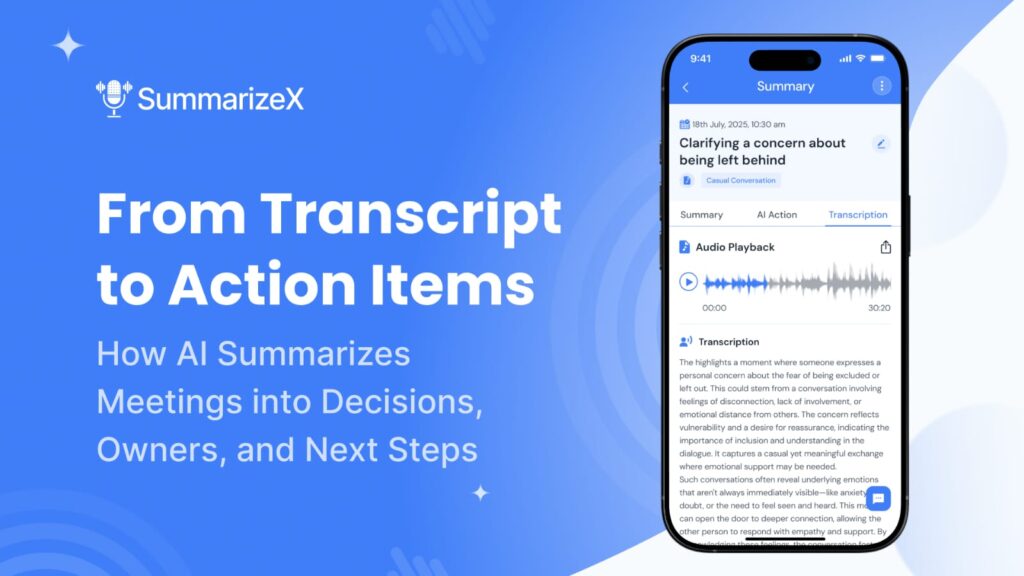
This is exactly the space SummarizeX is built for. Not just summarizing meetings, but making them actionable. Because honestly, summaries alone aren’t enough anymore.
With SummarizeX, the focus is on output that teams can immediately use:
- Decisions that are clearly defined
- Action items that are easy to track
- Owners that are explicitly assigned
- Next steps that don’t need further explanation
So instead of revisiting conversations, teams can move forward right away.
This isn’t really about saving time
A lot of tools position this as:
Save time on note-taking.
And yes, that happens.
But the bigger shift is this:
You improve how your team executes
Because when clarity improves:
- Work starts faster
- Responsibilities are clear
- Progress becomes consistent
And that’s what actually drives results.
A small shift that changes how teams work
If there’s one thing worth taking away from this, it’s this:
Meetings shouldn’t end with notes. They should end with direction.
That’s the difference between:
- Talking about work
- And actually moving work forward
A strong AI to summarize meeting transcript helps bridge that gap.
Final thought
Most meetings already contain everything needed to move forward:
- Ideas
- Decisions
- Tasks
The problem is – they’re buried inside conversations.
What AI does is simple:
It pulls those pieces out, organizes them, and makes them usable.
And once that happens, something interesting changes. You don’t feel the need for more meetings. You just get more out of the ones you already have.
Ready to make your meetings actually useful?
If your team still relies on:
- Memory
- Scattered notes
- Follow-up messages
There’s a better way to handle it.
A structured meeting minutes automation can turn every conversation into clear direction.
Using SummarizeX, you are not only capturing the meetings but also making them into decisions, owners and next steps in real-time.
And that’s where real productivity begins.